
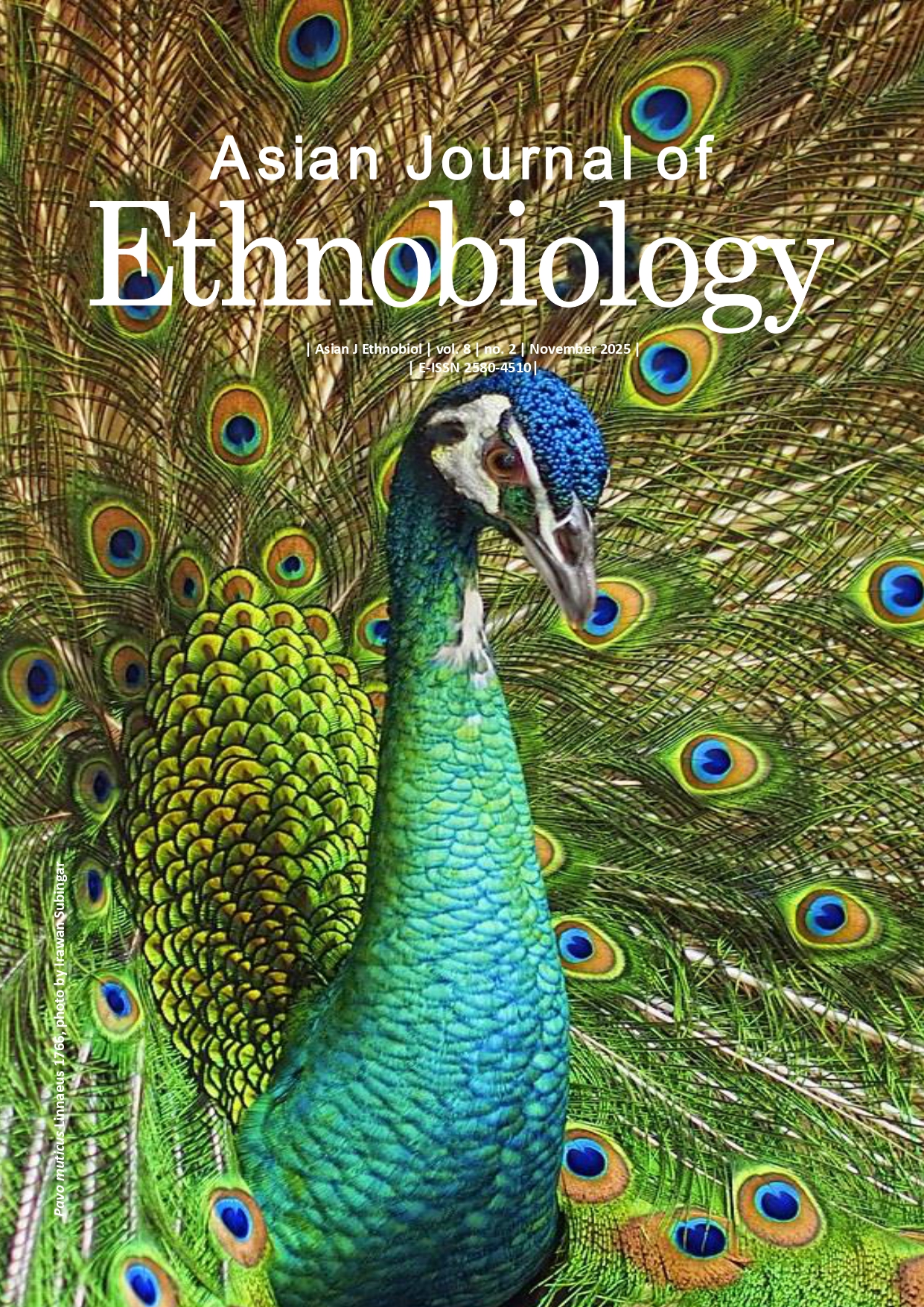
Etnozoological study of green peacock (Pavo muticus) on Jataka Relief at Candi Borobudur, Magelang, Indonesia
Article Sidebar
Abstract Views: 586
File Views: 42
Main Article Content
Abstract
Abstract. Prajoko S, Sukmawati I, Hastuari FA. 2025. Etnozoological study of green peacock (Pavo muticus) on Jataka Relief at Candi Borobudur, Magelang, Indonesia. Asian J Ethnobiol 8: 141-148. The green peacock (Pavo muticus Linnaeus, 1766) is one of the animals frequently depicted in the Jataka Reliefs at Borobudur Temple, Magelang District, Central Java, Indonesia; however, scientific research on the ethnozoology aspects remains limited. As a symbol of culture and spirituality in ancient Javanese Society, the presence of this bird in the reliefs has a deep philosophical meaning. This study aims to examine the representation of the green peacock in the Jataka Reliefs through morphological, morphometric, and cultural symbolism analysis. This study employed a qualitative approach with visual ethnographic methods, including direct observation, photographic documentation, and interviews with cultural and zoological experts. These interviews were crucial in gaining insights into the cultural and religious meanings of the peacock, as well as its role in ancient Javanese Society. Observations of the reliefs were conducted at Borobudur Temple, while comparative morphology was assessed through observations of live green peacocks at the Jagatsatwa Nusantara Bird Park in TMII. The results revealed 9 relief panels depicting green peacocks and 7 panels featuring peacock feather fans, with a dominant representation of males. Morphometric analysis revealed a 99.85% similarity in body proportions, indicating a high level of anatomical accuracy achieved by the ancient sculptors. Additionally, these findings suggest that peacocks were not merely decorative elements but served as symbols of spiritual transformation, purity, and protection within Buddhist teachings.
Article Details
Issue
Section
How to Cite
References
Adams, D. C., Rohlf, F. J., & Slice, D. E. (2004). Geometric Morphometrics: Ten Years Of Progress Following The 'Revolution'. Italian Journal of Zoology, 71(1), 5-16.
Adisa, Vanesa. (2023). Tracing the Life of Peacocks: Habitat, Species, and Conservation. Yogyakarta: Light of Hope
Alcock, J. (2013). Animal behavior: An evolutionary approach. Sinauer Associates.
Amanda, N. A., Lutfiana, D. I., & Radianto, D. O. (2024). Synergy of Green Peacock Conservation to Revitalize Reog Ponorogo Art. Journal Sains Student Research, 2(3), 678-689.
Amelia, G. (2022). Ethnozoological Study of Lampung Tribal People in Utilizing Animals as Traditional Medicine in Ngaras District, West Pesisir Regency (Doctoral Dissertation, Uin Raden Intan Lampung).
AMIR, M. (2022). Butterfly on the Island Bacan North Mollucas Province; How Density. International Journal of Engineering Research and Development.
?nandajoti, B. (2020). J?taka The Buddha's Past Birth Stories. Ehipassiko Foundation.
Ardiyansyah, P., Permana, D. I., Aristina, M., & Setiyawan, I. (2020). Interpretation of Gandawyuha Relief at Borobudur Temple: (Case Study of Gandawyuha Relief on the Wall of Aisle Ii). Journal of Cultural Heritage Conservation, 14(2), 16-41.
Ardyansyah, D. (2023). Birds (Aves). Bumi Aksara.
BirdLife International. (2018). Pavo muticus. The IUCN Red List of Threatened Species 2018: e.T22679440A131749282. https://dx.doi.org/10.2305/IUCN.UK.2018-2.RLTS.T22679440A131749282.en. Accessed on February 07, 2025.
Boer, C., & Rustam, R. (2020). Observation of Bird Species in the High Conservation Value Area of PT Gunung Gajah Abadi. Journal of Integrated Agriculture, 8(2), 154-163.
Borobudur, D. (2024, March 28). Demographic Profile of Borobudur Village December 2023. Retrieved from Borobudur Village: https://desaborobudur.magelangkab.go.id/desa/lokasi/upload/dokumen/DEMOGRAFI--PROFIL-DESA-BOROBUDUR DESEMBER-YEAR-2023.pdf.
Budiarto, M. T., Masruroh, A., Azizah, A., Munthahana, J., Awwaliya, R., Nikmah, R. A., & Yusrina, S. L. (2022). Ethnomathematics Study of Ethnomathematics in Indonesian Culture. Zifatama Jawara.
BUG, T. G. (2015). Pests and pest control. Center of excellence in marine biology, University of Karachi, Karachi, 126. African Journal of Ecology, 53(3), 365-372.
Cahyawati, N. D., Sukmawati, I., & Prajoko, S. (2023). Development of Ethnopedagogy-Based Reference Books on Mendut Temple Reliefs Vertebrate Sub-Materials. Indonesian Journal of Biology Education, 6(2), 95-100.
Change, I. P. O. C. (2007). Climate change 2007: the physical science basis. Agenda, 6(07), 333.
Clutton-Brock, T. H. (2016). Mammal societies. John Wiley & Sons.
Dececchi, T. A., Larsson, H. C., & Habib, M. B. (2016). The wings before the bird: an evaluation of flapping-based locomotory hypotheses in bird antecedents. PeerJ, 4, e2159.
Defandra, G. (2018). 3D Animation Application of Jataka Relief Story Based on Android Augmented Reality with Marker Based Tracking Method.
Dewi, C. S. U. (2022). Bioecology of seagrasses. Media Nusa Creative (Mnc Publishing).
Dhamija, J. (2004). Asian embroidery. Abhinav Publications.
Egerton, F. N. (2015). History of ecological sciences, part 55: animal population ecology. The Bulletin of the Ecological Society of America, 96(4), 560-626.
Eibeck, A., Shaocong, Z., Mei Qi, L., & Kraft, M. (2024). Research data supporting "A Simple and Efficient Approach to Unsupervised Instance Matching and its Application to Linked Data of Power Plants".
Fahrurozi, Y., Prajoko, S., & Permadani, K.P. (2024). Pengembangan Buku Referensi Biologi Berbasis Studi Etnosains Pada Relief Flora Candi Mendut. Jurnal Konservasi Cagar Budaya, 18(2), 110-132.
Fauzan, I. M. (2019). Population and Habitat of Javanese Green Peacock (Pavo muticus Linnaeus, 1766) in Peucang Island Resort, Ujung Kulon National Park.
Febrianto, R. & M. Idris. (2016). The story of fauna reliefs at candi Borobudur. Journal of History and History Learning 2(2): 44-56.
Fitrianti, E. (2022). Daily Behavior of Green Peacocks (Pavo Muticus) in Bontomarannu Education Park.
Ghufron, M., Fauzy, M., Samudera, A., Kamila, R. D., & Anugrah, F. (2024). Impact of Urban Environment on Climate Crisis. Journal of Interdisciplinary Humanities Studies, 8(11).
Gu, B., & Wang, F. (2021). A review on the ecology and conservation biology of green peafowl (Pavo muticus). Biodiversity Science, 29(11), 1554.
Gusti, Y. (2020). Development of a Literacy Model through Fairy Tales in Motivating Reading and Writing Based on Indonesian Language: English. Studia Komunika: Journal of Communication Science, 3(2), 34-43.
Hafizd, T. A., Camin, Y. R., & Mangunjaya, F. M. (2017). Level of Perception and Awareness of the Tanjung Beringin Village Community towards Mui Fatwa No. 04 concerning the Protection of Rare Animals for Ecosystem Balance. Himmah: Journal of Contemporary Islamic Studies, 1(01).
Henriques, M. (2022). Shorebirds in the Bijagós Archipelago: Interpreting Ecological Processes and Habitat Features Affecting Migratory Shorebirds in a Mangrove-Influenced Tidal Landscape (Doctoral dissertation, Universidade de Lisboa (Portugal)).
Hermadi, H. A. (2016). Reproductive Manipulation of Java Peafowl (Pavo muticus muticus). Veterinaria, 9(1).
Herupradoto, E. B. A., & Hermadi, H. A. (2015). Conservation impact on molecular genetic changes in Java green peacock (Pavo muticus) through mitochondrial D-loop markers. Ecology, Environment and Conservation, 21(2), 685-689.
Holvast, E. J., Celik, M. A., Phillips, M. J., & Wilson, L. A. (2024). Do Morphometric Data Improve Phylogenetic Reconstruction? A Systematic Review And Assessment. Bmc Ecology And Evolution, 24(1), 1-16.
Indonesia, C. (2022, June 7). 5 Myths and Mysteries of Borobudur Temple, Including about Touching the Contents of the Stupa. Retrieved from CNN Indonesia: https://www.cnnindonesia.com/gaya-hidup/20220607113913-269-805780/5-mitos-dan-misteri-candi-borobudur-termasuk-soal-menyentuh-isi-stupa/2.
Jain, A., & Jain, S. K. (2016). Indian Ethnobotany: Bibliography of 21st Century (2001-2015). Scientific Publishers.
Jinan, M. (2015). Muhammadiyah studies: The transformation of research on Islamic movement in Indonesia. Analysis Journal of Social Science and Religion, 22(2), 269-280.
Kristianingrum, Y. P., Asmara, W., & Wibowo, M. H. (2023). Characterization of Newcastle Disease Virus Isolated from Peacocks in Palembang City, South Sumatra. Journal of Veterinary Science, 41(1).
Kushwaha, S., & Kumar, A. (2016). A review on Indian peafowl (Pavo cristatus) Linnaeus, 1758. J Wildl Res, 4(4), 42-59.
Liandry, L. (2021). Male Peacock Feathers as a Source of Inspiration for Bracelet Jewelry Creation (Doctoral dissertation, ISI Yogyakarta).
Martin, G. R., & Martin, R. O. (2022). Psittaciformes sensory systems. In Encyclopedia of animal cognition and behavior (pp. 5767-5782). Cham: Springer International Publishing.
Maskur, A., Harto, D. B., & Wibawanto, W. (2020). Interactive Multimedia Design Of Jataka Borobudur Temple's Relief As A Learning Media For Elementary School Student. Arty: Journal of Fine Arts, 9(3), 225-238.
Mulyaningrum, M. (2020). Analysis of the Implementation of 21st Century Communication Skills in Chemistry Learning (Case Study in Ma Semarang City) (Doctoral Dissertation, Muhammadiyah University, Semarang).
Munandar, A. A. (2020). Majapahit And The Contemporary Kingdoms: Interactions And Views. Archaeology Periodical, 40(1), 1-22.
Muyaroah, S., & Fajartia, M. (2017). Development of Android-based learning media using Adobe Flash CS 6 application in biology subjects. Innovative Journal of Curriculum and Educational Technology, 6(2), 22-26.
Nabilla, Q., & Samadi, R. K. Social and Economic Observations for Sustainable Tourism Development at Borobudur Temple.
NADHIFAH, A., ZAKIYYAH, K., & NOVIADY, I. (2017, September). Diversity of epiphytic moss in genus Cupressus at Cibodas Botanic Gardens, West Java. In Proceedings of the National Seminar of the Indonesian Biodiversity Society (Vol. 3, No. 3, pp. 396-400).
Nurish, A. (2019). Muhammadiyah and the Currents of Radicalism. Maarif, 14(2), 59-74.
Peacock, A. C. S. (2018). Notes on some Persian documents from early modern Southeast Asia. History: Journal of the Department of History, 27(1 (June)).
Piranti, L. (2016). Development of Multi Representation Based Reference Book with Contextual Approach on Heat and Thermodynamics Material (Doctoral Dissertation, Universitas Negeri Jakarta).
Prajoko, S., Pamungkas, S.J., & Prasetyo A.P., (2022). Etnobotani Upacara Adat di Surakarta. Yogyakarata: Deepublish.
Prajoko, S., Alamsyah, M.R.N., & Yulia, N. (2023). Etnobotani Jamu, Yogyakarta: Deepublish.
Prajoko, S., Ramadani, S.D., Kusumawati, H., Pangestuti D., Cahayawati, N., D., & Fahrurozi, Y. 2024. Vertebrata Pada Relief Jataka dan Avadana Candi Borobudur. Magelang: Tidar Press.
Prasetyo, H., et al. (2023). Conservation of Endemic Birds in Indonesia. Jakarta: LIPI Press.
Pudyatmoko, S. (2019). Habitat and Spatio-Temporal Interactions of Green Peacocks with Cattle and Large Herbivores in Baluran National Park. Journal of Forestry Science, 13(1), 28-37.
Rohlf, F. J., & Bookstein, F. L. (2003). Computing the uniform component of shape variation. Systematic Biology, 52(1), 66-69.
Saputri, A. E., & Susilowibowo, J. (2020). Development of E-Book Teaching Materials in the Practical Subject of Manufacturing Company Research. Journal of Education Research, 20(2), 154-162.
Sasongko, C. T., & Susanti, N. (2021). Pu Sapi and Lembu Agra: An Anthroponymy Study Based on the Contents of Ancient Javanese Inscriptions (9th-16th Century AD). Paradigma: Journal of Cultural Studies, 11(2), 1.
Semuel, H., Mangoting, Y., & Hatane, S. E. (2022). The meaning of quality and performance of Indonesian traditional weaving in collaboration with national culture and organizational culture. The Meaning of Quality and Performance of Indonesian Traditional Weaving Collaboration of National Culture and Organizational Culture.
Setyawan H., B. Kasatriyanto, A. Kristiyanto, & AC. Santoso 2017. Resume of Borobudur Area Vegetation Arrangement Study
Sugianto, H. (2019). Peacock Motif Relief at Pesarean Sunan Sendang Duwur Paciran Lamongan: A Study of Form, Meaning and Aesthetics. Journal of Nusantara Culture, 3(1), 61-74.
Suherini, T. (2021). Green Peacock as a Source of Idea for Batik Motif Creation in Women's Work Clothing. Ornaments, 18(1).
Sujatmiko, T., Pranoto, R., & Wulandari, D. (2019). Anatomy and Morphometry of the Green Peacock. Journal of Tropical Biology, 17(2), 85-93.
Sun, K., Meiklejohn, K. A., Faircloth, B. C., Glenn, T. C., Braun, E. L., & Kimball, R. T. (2014). The evolution of peafowl and other taxa with ocelli (eyespots): a phylogenomic approach. Proceedings of the Royal Society B: Biological Sciences, 281(1790), 20140823.
Suryani, D. (2021). Fauna Symbolism in Temple Reliefs in Java. Semarang: Widya Wacana Press.
Susanti, R., Suhendi, D., Amalia, R., & Wahyuni, F. S. (2025). Flora and Fauna Motifs in Hindu Temples of the Srivijaya Period for History Learning. Journal of Hinduism Research, 9(1), 71-94.
SYIFA, N. (2022). Methodological Study of Ethological Science (Doctoral dissertation, Uin Raden Intan Lampung).
Takandjandji, M., & Sawitri, R. (2016). Morphometric and Meristic Measures of the Javan Pangolin (Manis Javanica Desmarest, 1822) from Sumatra, Java, and Kalimantan. Germplasm Bulletin, 22(2), 149-160.
Trisnayanti, C. (2015). Study of Form and Meaning of Sojiwan Temple Relief (Doctoral dissertation, Institut Seni Indonesia (Isi) Surakarta).
Ulfahira, A. J. (2024). Borobudur Temple as Indonesia's Competitive Identity in World Heritage Sites (Doctoral dissertation, Universitas Islam Indonesia).
Wahyuningsih, S., Silvia, M. Y. R., Naqiya, A., Alviana, K. Y., Husnia, U., Deffiani, A., & Maula, P. N. M. (2024). Portrait of Local Wisdom of Kemiri Village Community. Adab Publisher.
Wibowo, B., Suherlan, H., Hidayah, N., & Nurrochman, M. (2022). An Analysis of Collaborative Governance of an Independent and Sustainable Tourism Village: An Empirical Investigation of Ngargoretno-Magelang. Journal of Tourism: Destination, Hospitality and Travel, 6(1), 75-84.
Wulandari, E. A. (2019). Carving Motifs in the Creation of Typical Jepara Batik. Dynamics of Crafts and Batik, 36(1), 17-34.
Wulandari, A. (2022). Batik Nusantara: Philosophical meaning, how to make, and the batik industry. Andi Publisher.
Yatno, T. Y. T. (2022). Fungsi dan Nilai Candi Borobudur di Era Globalisasi. Sabbhata Yatra: Jurnal Pariwisata dan Budaya, 3(2), 72-81.