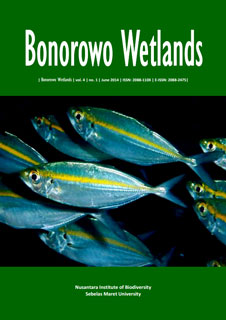
Bioeconomic analysis for management of yellowstripe scad (Selaroides leptolepis, Cuvier and Valenciennes) landed in Karangantu, Banten
Article Sidebar
Abstract Views: 219
File Views: 340
Main Article Content
Abstract
Abstract. Mayalibit DNK, Kurnia R, Yonvitner. 2014. Bioeconomic analysis for management of yellowstripe scad (Selaroides leptolepis, Cuvier and Valenciennes) landed in Karangantu, Banten. Bonorowo Wetlands 4: 49-57. Yellowstripe scad (Selaroides leptolepis) is a small pelagic fish which has economically important. The purpose of this study is to determine the economic aspects of the Yellowstripe scad (Selaroides leptolepis, Cuvier, and Valenciennes) population from the Bay of Banten. The models used in this study were Schaefer, Fox, Walter Hilborn, CYP, and Schnute surplus production models. Fox models had the highest coefficient of determination (R2) value than the others surplus production models. This coefficient of determination (R2) value model was 78%, with maximum sustainability yield (MSY) was 89.289 kg/year, and its effort (Fmsy) was 2.462 trips/year. Bioeconomic analysis of MEY was 87.517 kg/year, and Fmey was 2.001 trips/year. Bioeconomic analysis showed that Factual value greater than Fmsy and Fmey. It indicates that Yellowstripe scad has been in overfishing condition economically. The management regime of MEY is better because it gets a catch effort and TC that was smaller and larger profit than management of MSY and open access. The plan for fish stock management for Yellowstripe scad in PPN Karangantu is to control the catch’s effort and gears selectivity.
Article Details
Issue
Section

This work is licensed under a Creative Commons Attribution-NonCommercial-ShareAlike 4.0 International License.
The journal is committed to free-open access that does not charge readers or their institutions for access. Readers are entitled to read, download, copy, distribute, print, search, or link to the full texts of articles, as long as not for commercial purposes. The license type is CC-BY-NC-SA.