Habitat heterogeneity influences Odonata (Arthropoda: Insecta) diversity and reveals a new record from Mindanao, Philippines
Article Sidebar
Abstract Views: 437
File Views: 340
Main Article Content
Abstract
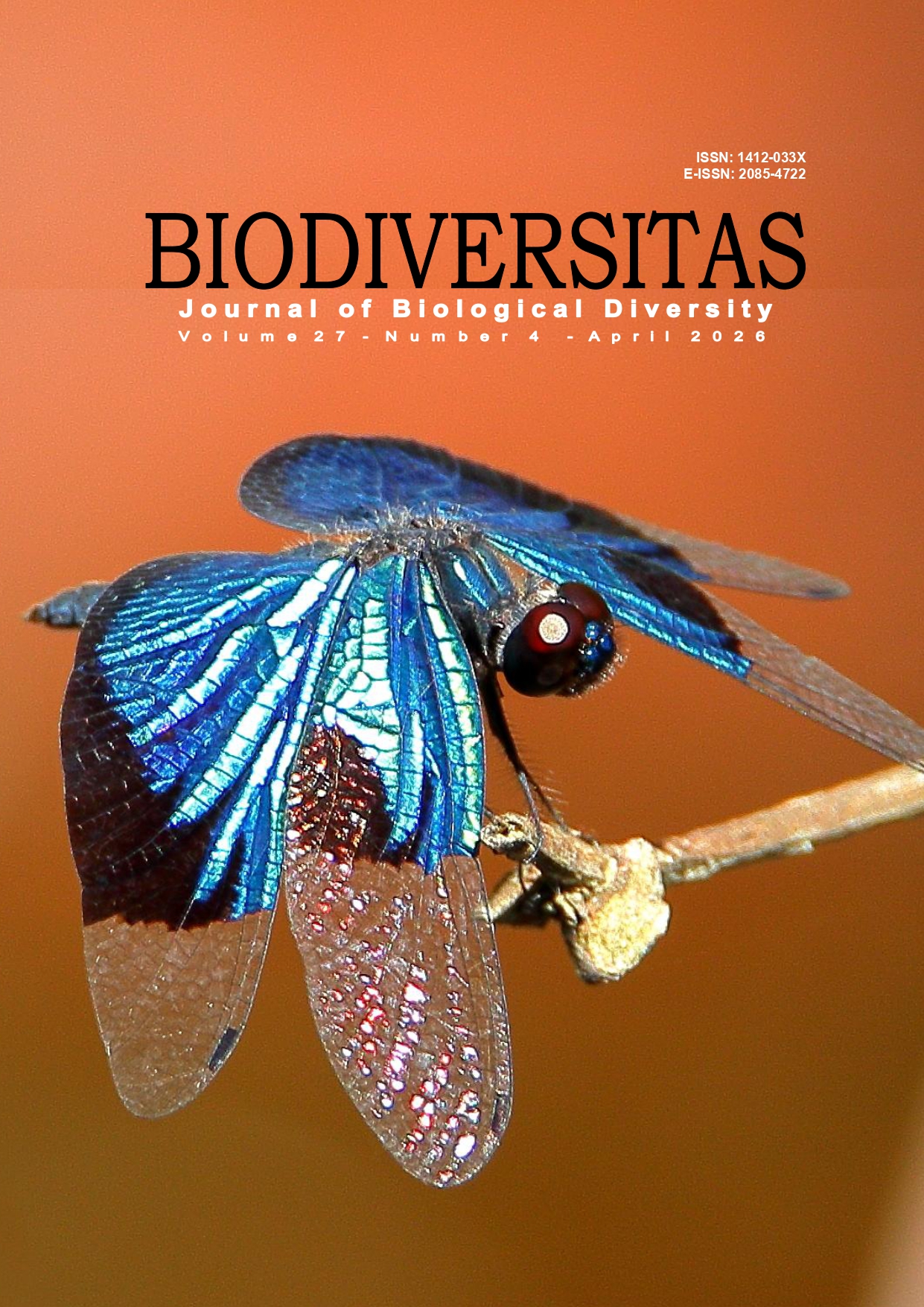
Abstract. Manangan JLV, Omandam JE, Nuñeza OM, Villanueva RJT. 2026. Habitat heterogeneity influences Odonata (Arthropoda: Insecta) diversity and reveals a new record from Mindanao, Philippines. Biodiversitas 27 (4): d270402. https://doi.org/10.13057/biodiv/d270402. Sitio Talangisog, an ancestral domain in Misamis Oriental, is one of the remaining dipterocarp forest frontiers in the province and contains a mosaic of interconnected freshwater habitats. This study assessed Odonata assemblages across three sampling sites in each of four habitat types using standardized time-constrained sampling with sweep-netting and handpicking during the dry (January-February 2025) and wet (June 2025) seasons. Systematic sampling recorded 52 species belonging to 12 families and 39 genera. Twenty-four species are endemic, including five of conservation concern: one Near Threatened, two Vulnerable, and two Endangered, notably Drepanosticta clados and Sangabasis bukid. The Asian bronze flutterer, Rhyothemis obsolescens, represents the first confirmed record from Mindanao Island and only the second national record in more than three decades. The most frequently encountered species was Risiocnemis appendiculata (7.12%), while Prodasineura integra occurred in all habitat types. One additional species, the endemic and Vulnerable Indaeschna baluga, was recorded incidentally and excluded from quantitative analyses but reported as a species record. Habitat-averaged diversity indices (n: 3 sites per habitat) were highest in lentic habitats. Bray-Curtis similarity revealed compositional affinity between open and shaded lotic habitats and between lentic and agroecosystems. Distance-based redundancy analysis (db-RDA), supported by non-metric multidimensional scaling (NMDS), showed that environmental variables significantly structured species composition (p: 0.005, adjusted R²: 0.742), with dissolved oxygen, pH, relative humidity, and water temperature identified as significant drivers. Species turnover followed a gradient from warmer, slightly acidic, lower-oxygen waters dominated by generalists in lentic and agroecosystems to cooler, slightly alkaline, well-oxygenated lotic habitats preferred by many endemics. These findings highlight the role of habitat heterogeneity in structuring Odonata communities and emphasize the conservation value of Sitio Talangisog as a refuge for endemic and threatened species.
Article Details
Issue
Section

This work is licensed under a Creative Commons Attribution-NonCommercial-ShareAlike 4.0 International License.
References
Allan JD, Castillo M. 2007. Stream Ecology: Structure and Function of Running Waters. Springer, Dordrecht.
Aspacio K, Yuto C, Nuñeza O, Villanueva RJ. 2013. Species diversity of Odonata in selected areas of Buru-un, Iligan City and Tubod, Lanao del Norte, Philippines. Anim Biol Anim Husb 5 (2): 145-155. https://doi.org/10.5281/zenodo.8188326.
Bánki O, Roskov Y, Döring M, Ower G, Hernández-Robles DR, Plata-Corredor CA, Stjernegaard J, Örn A, Pape T, Hobern D, Garnett S, Little H, DeWalt RE, Miller J, Orrell T, Aalbu R, Abbott J, Aedo C, Aescht E. 2025. Catalogue of Life. Catalogue of Life Foundation, Amsterdam, Netherlands. www.catalogueoflife.org.
Botterill-James T, Yates L, Buettel J, Brook B. 2024. The future of Southeast Asia's biodiversity: A crisis with a hopeful alternative. Biol Conserv 296: 110641. https://doi.org/10.1016/j.biocon.2024.110641.
Bried JT, Samways MJ. 2015. A review of odonatology in freshwater applied ecology and conservation science. Freshw Sci 34 (3): 1023-1031. https://doi.org/10.1086/682174.
Brito J, Calvão L, Cunha E, Maioli L, Barbirato M, Rolim S, Juen L. 2021. Environmental variables affect the diversity of adult damselflies (Odonata: Zygoptera) in western Amazonia. Intl J Odonatol 24: 108-121. https://doi.org/10.23797/2159-6719_24_8.
Cezário R, Firme PP, Pestana G, Vilela D, Juen L, Cordero-Rivera A, Guillermo-Ferreira R. 2021. Sampling methods for dragonflies and damselflies. In: Santos JC, Fernandes GW (eds). Measuring Arthropod Biodiversity. Springer, Cham.
Daso JM, Arquisal IB, Yuto CM, Mondejar E. 2021. Species diversity of Odonata in Bolyok Falls, Naawan, Misamis Oriental, Philippines. AACL Bioflux 14 (2): 664-671. https://doi.org/10.5281/zenodo.8197103.
DENR [Department of Environment and Natural Resources]. 2019. DENR Administrative Order No. 2019-09: Updated National List of Threatened Philippine Fauna and Their Categories. https://elibrary.bmb.gov.ph/ elibrary/wp-content/uploads/2023/05/dao-2019-09.pdf.
Department of Science and Technology-Philippine Atmospheric, Geophysical and Astronomical Services Administration (DOST-PAGASA). 2024. CliMap v2.0: Combined In Situ and Satellite-based Daily Rainfall Data of the Philippines in High-Resolution Grids. DOST-PAGASA, Quezon City, Philippines. https://www.pagasa.dost.gov.ph/climate/ climate-change/dynamic-downscaling/climap-v2.
Dolný A, Harabiš F, Mižičová H. 2014. Home range, movement, and distribution patterns of the threatened dragonfly Sympetrum depressiusculum (Odonata: Libellulidae): A thousand times greater territory to protect? Plos One 9 (7): e100408. https://doi.org/10.1371/journal.pone.0100408.
Dolný A, Ožana S, Burda M, Harabiš F. 2021. Effects of landscape patterns and their changes to species richness, species composition, and the conservation value of Odonates (Insecta). Insects 12 (6): 478. https://doi.org/10.3390/insects12060478.
Dow R. 2020a. Cyrano angustior. IUCN Red List Threat Species. https://doi.org/10.2305/IUCN.UK.2020-1.RLTS.T139440885A1466-02130.en.
Dow R. 2020b. Devadatta basilanensis. IUCN Red List Threat Species. https://doi.org/10.2305/IUCN.UK.2020-1.RLTS.T139354211A146602115.en.
Dow R. 2020c. Drepanosticta clados. IUCN Red List Threat Species. https://doi.org/10.2305/IUCN.UK.2020-1.RLTS.T139566082A1466-02570.en.
Dow R. 2020d. Indaeschna baluga. IUCN Red List Threat Species. https://doi.org/10.2305/IUCN.UK.2020-1.RLTS.T139069705A1391-18453.en.
Dow R. 2020e. Sangabasis bukid. IUCN Red List Threat Species. https://doi.org/10.2305/IUCN.UK.2020-1.RLTS.T139544736A1466-02170.en.
Gapud V. 2006. Damselflies (Odonata: Zygoptera) of Greater Luzon, Philippines with description of two new species. Philipp Entomol 19 (2): 1-42.
GBIF [Global Biodiversity Information Facility]. 2025. GBIF Occurrence Download for Rhyothemis obsolescens. https://www.gbif.org.
Hämäläinen M, Müller RA. 1997. Synopsis of the Philippine Odonata, with lists of species recorded from forty islands. Odonatologica 26: 249-315.
Hämäläinen M. 2004. Critical species of Odonata in the Philippines. Intl J Odonatol 7: 305-310. https://doi.org/10.1080/13887890.2004.9748218.
Hankin DG, Reeves GH. 1988. Estimating total fish abundance and total habitat area in small streams based on visual estimation methods. Can J Fish Aquat Sci 45 (5): 834-844. https://doi.org/10.1139/f88-101.
Hsieh TC, Ma K, Chao A. 2016. iNEXT: An R package for rarefaction and extrapolation of species diversity (Hill numbers). Methods Ecol Evol 7 (12): 1451-1456. https://doi.org/10.1111/2041-210X.12613.
Hykel M, Harabis F, Dolný A. 2016. Assessment of the quality of the terrestrial habitat of the threatened dragonfly, Sympetrum depressiusculum (Odonata: Libellulidae). Eur J Entomol 113: 476-481. https://doi.org/10.14411/eje.2016.062.
IUCN [International Union for Conservation of Nature]. 2025. The IUCN Red List of Threatened Species. www.iucnredlist.org.
Janssen A, Hunger H, Konold W, Pufal G, Staab M. 2018. Simple pond restoration measures increase dragonfly (Insecta: Odonata) diversity. Biodivers Conserv 27: 2311-2328. https://doi.org/10.1007/s10531-018-1539-5.
Kalkman V, Boudot JP, Bernard R, De Knijf G, Suhling F, Termaat T. 2018. Diversity and conservation of European dragonflies and damselflies (Odonata). Hydrobiologia 811: 269-282. https://doi.org/10.1007/s10750-017-3495-6.
Khelifa R. 2019. Sensitivity of biodiversity indices to life history stage, habitat type and landscape in Odonata community. Biol Conserv 237: 63-69. https://doi.org/10.1016/j.biocon.2019.06.010.
Kirby WF. 1889. A revision of the subfamily Libellulinae, with descriptions of new genera and species. J Linn Soc Lond Zool 20: 289-409.
Kohli M, Letsch H, Greve C, Béthoux O, Deregnaucourt I, Liu S, Zhou X, Donath A, Mayer C, Podsiadlowski L, Gunkel S, Machida R, Niehuis O, Rust J, Wappler T, Yu X, Misof B, Ware J. 2021. Evolutionary history and divergence times of Odonata (dragonflies and damselflies) revealed through transcriptomics. iScience 24 (11): 103324. https://doi.org/10.1016/j.isci.2021.103324.
Kosterin O. 2012. Odonata of the Cambodian coastal regions in late rainy season of 2011. Intl Dragonfly Fund 45: 1-102.
Kuznetsova V, Golub N. 2020. A checklist of chromosome numbers and a review of karyotype variation in Odonata of the world. Comp Cytogenet 14 (4): 501-540. https://doi.org/10.3897/CompCytogen.v14i4.57062.
Leksono AS, Feriwibisono B, Arifianto T, Pratama AF. 2017. The abundance and diversity of Odonata along an altitudinal gradient in East Java, Indonesia. Entomol Res 47 (4): 248-255. https://doi.org/10.1111/1748-5967.12216.
Malawani A, Ampang-Macabuat N, Nuñeza O, Villanueva RJ. 2014. Odonata of Lanao del Sur, Mindanao, Philippines. Intl Res J Biol Sci 3 (1): 42-48.
Manangan JL, Maceda J, Omandam J, Nuñeza O, Villanueva RJ. 2026. Forest dependency and diversity of Odonata (Arthropoda: Insecta) in Mt. Balatukan Range Natural Park, Philippines. Environ Res Commun 8: 035023. https://doi.org/10.1088/2515-7620/ae57fe.
Manu MK, Ashiagbor G, Seidu I, Groen T, Gyimah T, Toxopeus B. 2023. Odonata as bioindicator for monitoring anthropogenic disturbance of Owabi wetland sanctuary, Ghana. Aquat Insects 44 (2): 151-169. https://doi.org/10.1080/01650424.2022.2108844.
Mapi-ot EF, Taotao AU, Nuñeza O, Villanueva RJ. 2013. Species diversity of adult Odonata in selected areas from Misamis Occidental Province, Philippines. AACL Bioflux 6 (4): 421-432.
Margalef R. 1958. Temporal succession and spatial heterogeneity in phytoplankton. In: Buzzati-Traverso A (eds). Perspectives in Marine Biology. University of California Press, Berkeley.
Mendes TP, de Assis Montag LF, Alvarado S, Juen L. 2021. Assessing habitat quality on alpha and beta diversity of Odonata larvae (Insect) in logging areas in Amazon Forest. Hydrobiologia 848: 1147-1161. https://doi.org/10.1007/s10750-021-04524-x.
Mendes TP, Luiza-Andrade A, Cabette HS, Juen L. 2018. How does environmental variation affect the distribution of dragonfly larvae (Odonata) in the Amazon-Cerrado transition zone in Central Brazil? Neotrop Entomol 47: 37-45. https://doi.org/10.1007/s13744-017-0506-2.
Minot M, Besnard A, Husté A. 2021. Habitat use and movements of a large dragonfly (Odonata: Anax imperator) in a pond network. Freshw Biol 66 (2): 241-255. https://doi.org/10.1111/fwb.13632.
Oksanen J, Simpson GL, Blanchet FG, Kindt R, Legendre P, Minchin PR, O’Hara RB, Solymos P, Stevens MH, Szoecs E, Wagner H. 2024. Vegan: Community Ecology Package (R Package). https://cran.r-project.org.
Okude G, Futahashi R. 2021. Pigmentation and color pattern diversity in Odonata. Curr Opin Genet Dev 69: 14-20. https://doi.org/10.1016/j.gde.2020.12.014.
Paulson D, Schorr M, Deliry C. 2025. World Odonata List. University of Puget Sound, Tacoma, USA. www.pugetsound.edu/academics/academic-resources/slater-museum/biodiversity-resources/dragonflies/world-odonata-list2/.
Pereira-Moura L, Veras DS, de Carvalho FG, Juen L, Couceiro SRM. 2023. Habitat specificity and morphology-main filters for the distribution of Odonata in the Cerrado Maranhense, Brazil. Aquat Ecol 57: 443-458. https://doi.org/10.1007/s10452-023-10021-1.
PAGASA [Philippine Atmospheric, Geophysical and Astronomical Services Administration]. 2020. PAGASA climatological normal (1991-2020). www.pagasa.dost.gov.ph/climate/climate-monitoring#daily-rainfall-and-temperature.
Pielou EC. 1975. Ecological Diversity. John Wiley and Sons, New York.
Pimenta PC, Pelli A. 2019. The life of dragonflies: order Odonata. Cienc Nat 41: 1-7. https://doi.org/10.5902/2179460X32305.
R Core Team. 2025. R: A Language and Environment for Statistical Computing. R Foundation for Statistical Computing, Vienna, Austria. www.R-project.org/.
Ramos KA, Nuñeza O, Villanueva RJ. 2020. Species diversity of Odonata in Mimbilisan Protected Landscape, Misamis Oriental, Philippines. Asian J Conserv Biol 9 (2): 280-289.
Ramos L, Gapud V. 2007. Survey of dragonflies and damselflies (Odonata) of Mount Makiling, Luzon, Philippines. Philipp Entomol 21 (1): 1-75.
Sakai M, Suda S, Okeda T, Nomura R, Washitani I. 2019. The importance of riparian subtropical lucidophyllous forest to Odonata conservation. Aquat Conserv Mar Freshw Ecosyst 29 (5): 682-692. https://doi.org/10.1002/aqc.3099.
Sarsavan A, Pawar M, Sharma SK, Paliwal V. 2025. Lesser Blue-wing Rhyothemis triangularis Kirby, 1889 (Insecta: Libellulidae), a new addition to the dragonfly diversity of Rajasthan, India. J Threat Taxa 17 (6): 27167-27170. https://doi.org/10.11609/jott.9392.17.6.27167-27170.
Schneider CA, Rasband WS, Eliceiri KW. 2012. NIH Image to ImageJ: 25 years of image analysis. Nat Methods 9 (7): 671-675. https://doi.org/10.1038/nmeth.2089.
Seidu I, Nsor CA, Danquah E, Tehoda P, Oppong S. 2019. Patterns of Odonata assemblages in lotic and lentic systems in the Ankasa Conservation Area, Ghana. Intl J Zool 2019: 3094787. https://doi.org/10.1155/2019/3094787.
Shannon CE, Wiener W. 1963. The Mathematical Theory of Communication. University of Illinois Press, Urbana, IL.
Subramanian KA, Babu R. 2019. Dragonflies and damselflies (Insecta: Odonata) of India. In: Ramani S, Prashanth M, Yeshwanath HM (eds). Indian Insects: Diversity and Science. CRC Press, Boca Raton, FL.
Susanto MA, Gama Z, Leksono A. 2024. Habitat characteristics and threats of little-known endemic dragonfly, Neurothemis feralis (Burmeister, 1839) (Odonata: Libellulidae) in East Java, Indonesia. Biodiversitas 25 (7): 2907-2920. https://doi.org/10.13057/biodiv/d250712.
Vilela D, Ferreira R, Del-Claro K. 2016. The Odonata community of a Brazilian vereda: seasonal patterns, species diversity and rarity in a palm swamp environment. Biosci J 32 (2): 486-495. https://doi.org/10.14393/BJ-v32n2a2016-30491.
Vilenica M, Brigić A, Štih Koren A, Koren A, Sertić Perić M, Schmidt B, Bužan T, Gottstein S. 2024. Odonata assemblages in urban semi-natural wetlands. Insects 15 (3): 207. https://doi.org/10.3390/insects15030207.
Vilenica M, Kerovec M, Pozojević I, Mihaljević Z. 2021. Odonata assemblages in anthropogenically impacted lotic habitats. J Limnol 80 (1): 1968. https://doi.org/10.4081/jlimnol.2020.1968.
Villanueva RJ, Dow R. 2014. Review of the Philippine taxa formerly assigned to the genus Amphicnemis Selys, II. Genus Sangabasis with descriptions of eight new species (Odonata: Coenagrionidae). Zootaxa 3815 (1): 1-28. https://doi.org/10.11646/zootaxa.3815.1.1.
Villanueva RJ. 2009. Coeliccia exoleta. IUCN Red List Threat Species. https://doi.org/10.2305/IUCN.UK.2009.RLTS.T169293A6607978.en.
Villanueva RJ. 2011. Odonata fauna of Diomabok Lake and its surroundings, Davao Oriental, Mindanao Island, Philippines. Intl Dragonfly Fund 38: 1-29.
Wickham H. 2016. ggplot2: Elegant Graphics for Data Analysis. Springer International Publishing, Cham.
Wijesooriya MM, Jayalath MG, Perera SJ, Samanmali C. 2022. The Odonate fauna (Insecta: Odonata) of Belihuloya, southern intermediate zone of Sri Lanka: A preliminary assessment and conservation implications. J Asia Pac Biodivers 15 (3): 311-328. https://doi.org/10.1016/j.japb.2022.04.003.